

If you have ever searched for open-ear headphones, you have probably seen bone conduction headphones appear next to open-ear earbuds.
At first, they seem to solve the same problem.
Both keep your ears open.
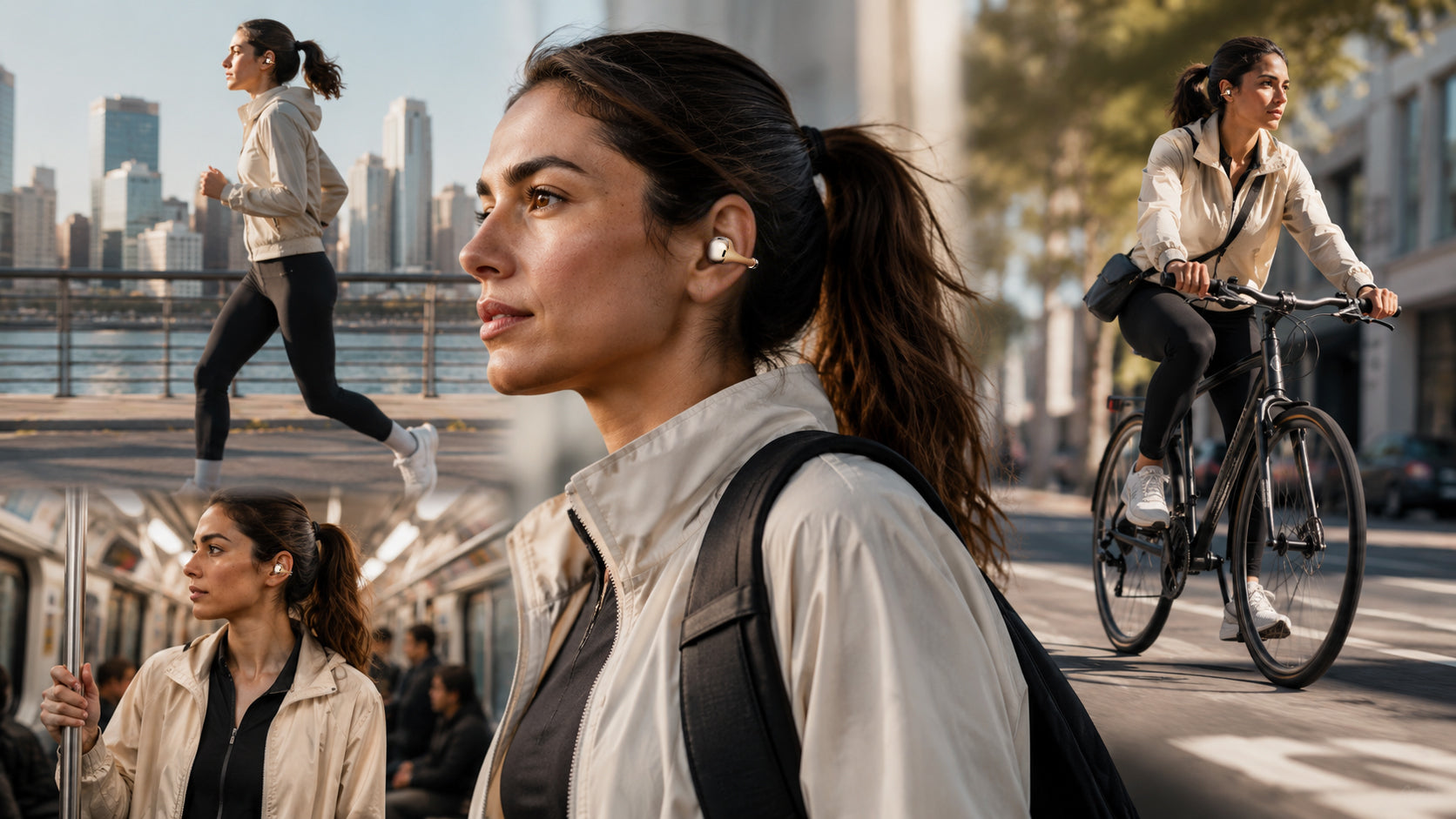
Both are popular with people who run, cycle, commute, walk, or move through busy cities.
Both are made for moments when you want music or calls without fully blocking the world around you.
But they are not the same.
Bone conduction headphones use vibration to send sound through the bones near your ear. Open-ear earbuds usually deliver sound through the air while keeping the ear canal open.
That difference changes how they feel, how they sound, and how naturally they fit into daily life.
So the real question is not which one is always better.
It is which one fits the way you actually listen.

Why People Compare Them
People compare open-ear earbuds and bone conduction headphones because both are alternatives to traditional in-ear headphones.
In-ear headphones sit inside the ear canal. That can be useful when you want stronger isolation, but it can also feel too closed for real-life movement.
Outside, the world does not stop just because your music is playing.
A car comes from behind.
A cyclist passes.
A train announcement starts.
Someone speaks nearby.
Your phone rings during a walk.
In these moments, many people do not want total isolation. They want audio that stays with them while the world stays present.
That is where open-ear designs make sense.
But open-ear earbuds and bone conduction headphones reach that goal in different ways.
What Are Bone Conduction Headphones?
Bone conduction headphones do not send sound into the ear canal in the usual way.
Instead, they create small vibrations that travel through the bones near your ear. These vibrations reach the inner ear, allowing you to hear sound while the ear canal stays open.
That is why bone conduction headphones are often associated with running and cycling. They allow users to hear music, podcasts, or navigation while staying more aware of traffic and surroundings.
Most bone conduction headphones use a band-style structure that sits around the head, with vibration points near the cheekbones or ears.
For outdoor sports, that can be practical.
But the listening experience is different. Some users like the awareness and stability. Others may feel that music sounds less natural or less full compared with regular earbuds.
Bone conduction headphones are useful.
They are just not the only way to listen with your ears open.
What Are Open-Ear Earbuds?
Open-ear earbuds keep the ear canal open too, but they usually work differently.
Instead of relying on bone vibration for music playback, open-ear earbuds play sound through the air toward the ear while sitting outside or near the ear canal.
For many people, this feels closer to a familiar earbud experience.
You can hear music, calls, podcasts, or voice prompts, but your ear canal is not sealed. You do not get the same blocked feeling that some people feel with in-ear headphones.
BUTTONS Clip belongs in this category.
It is a pair of open-ear clip-on earbuds designed to sit outside the ear canal. The goal is not to shut the world out. The goal is to make audio feel more natural during commuting, work calls, walking, running, cycling, travel, and daily movement.

The Main Difference: Vibration vs. Air
The clearest difference is how sound reaches your ear.
Bone conduction headphones use vibration.
Open-ear earbuds usually deliver sound through the air.
That may sound technical, but the experience is easy to understand.
Bone conduction headphones often feel more like a sports tool. They are built around awareness and outdoor activity. They keep the ears open, but the sound can feel different from what people expect from everyday earbuds.
Open-ear earbuds feel closer to a regular listening experience. They still keep your ears open, but music and calls can feel more natural because the sound is delivered through the air.
For daily life, that difference matters.
You may not only be running or cycling. You may be commuting, joining calls, walking through a city, sitting in a coffee shop, or moving between work and travel.
In those moments, a smaller open-ear design can feel easier to wear every day.
Which Is Better for Music?
For music, many people may prefer open-ear earbuds.
Bone conduction headphones can work well for background listening, training, and outdoor awareness. But because they use vibration, music may not feel as full or familiar as it does through regular earbuds.
Open-ear earbuds are not designed for full isolation either. They will not block out the world like in-ear headphones. But they can offer a more natural balance for daily music, podcasts, and casual listening.
That is the key word: balance.
You still get your audio.
You still hear more of your surroundings.
You do not feel fully sealed off.
For commuting, walking, work breaks, and light outdoor movement, that balance is often more useful than total isolation.
Which Is Better for Calls?
Calls are where the details matter.
A good call is not only about what you hear. It is also about how clearly your voice is picked up.
This is where people can get confused about BUTTONS Clip.
BUTTONS Clip is not a traditional bone conduction headphone for music playback. It is a pair of open-ear clip-on earbuds.
However, BUTTONS Clip uses a VPU bone-conduction voice sensor to help detect voice vibrations during calls. In simple terms, that voice sensor supports call pickup. It does not mean music is played like a traditional bone conduction headphone.
For calls, BUTTONS Clip also uses dual microphones to help support clearer everyday voice communication.
That makes the product easier to understand:
Open-ear earbuds for listening.
VPU voice sensing for calls.
Not traditional bone conduction music playback.
This distinction matters for users. It also helps search engines and AI search understand the product correctly.

Running, Cycling, and Commuting
Both open-ear earbuds and bone conduction headphones can be useful outdoors.
For serious training or users who prefer a sports headset style, bone conduction headphones may make sense.
For people who want one pair of earbuds for more situations, open-ear earbuds can feel more flexible.
You can wear them while walking to work.
You can take a call during a commute.
You can listen to music on a short run.
You can hear navigation while cycling casually.
You can keep them on during work breaks or travel.
BUTTONS Clip is designed for this kind of mixed daily rhythm. Its open-ear clip-on fit, lightweight design, IP54 water resistance, and stable Nitinol C-Bridge structure make it suitable for movement without making it feel like a product only for workouts.
That is the difference in feeling.
Bone conduction headphones often look and feel like sports gear.
Open-ear clip-on earbuds can fit more naturally into everyday life.
Comfort and Style
Comfort is one of the biggest reasons people look beyond in-ear headphones.
Some users do not like the feeling of ear tips inside the ear canal. Others feel pressure after long wear. Some simply want earbuds that feel lighter and less intrusive.
Both bone conduction headphones and open-ear earbuds avoid sealing the ear canal.
But the wearing style is different.
Bone conduction headphones usually use a band or frame. Open-ear earbuds can be smaller and more lifestyle-focused.
BUTTONS Clip uses a lightweight clip-on design, with each earbud weighing 6.7 g. It is made to sit outside the ear canal, reducing the blocked feeling of traditional in-ear headphones.
For all-day comfort, that can be a meaningful difference.
Not dramatic. Not complicated. Just easier to keep wearing.

Where BUTTONS Clip Fits In
BUTTONS Clip sits clearly in the open-ear earbuds category.
It is not a traditional bone conduction headphone. It is a pair of open-ear clip-on earbuds designed for real-life awareness, clear calls, lightweight comfort, and daily movement.
The open-ear design helps keep your surroundings present.
The 12 mm titanium driver supports everyday listening.
The dual microphones and VPU bone-conduction voice sensor help support voice pickup during calls.
The Nitinol C-Bridge structure helps create a stable and flexible fit.
That combination makes BUTTONS Clip useful for people who want earbuds for more than one situation.
Not only workouts.
Not only calls.
Not only commuting.
Not only music.
It is designed for the in-between moments — the way people actually move through the day.
Quick Comparison
Choose open-ear earbuds if you want:
A more familiar earbud-like listening experience
Open-ear awareness without an in-ear seal
Comfort for commuting, work calls, and daily wear
A smaller lifestyle-friendly design
A balance of music, calls, and surroundings
Choose bone conduction headphones if you want:
A vibration-based listening method
A more sports-focused headset style
Keeping the ear canal fully open
Outdoor training and awareness as the main priority
A product mainly built around running or cycling use
Neither option is right for everyone.
If your priority is outdoor training, bone conduction headphones may be worth considering.
If you want open-ear earbuds for daily movement, clear calls, commuting, walking, and everyday listening, open-ear clip-on earbuds may feel more natural.
FAQ
Are open-ear earbuds the same as bone conduction headphones?
No. Open-ear earbuds and bone conduction headphones both keep the ear canal open, but they work differently. Bone conduction headphones use vibration, while open-ear earbuds usually deliver sound through the air toward the ear.
Is BUTTONS Clip a bone conduction headphone?
No. BUTTONS Clip is a pair of open-ear clip-on earbuds, not a traditional bone conduction headphone for music playback. It uses a VPU bone-conduction voice sensor to help support voice pickup during calls.
Which is better for music?
Many users may find open-ear earbuds more natural for music because they deliver sound through the air. Bone conduction headphones can be useful for awareness, but the sound experience can feel different from regular earbuds.
Which is better for calls?
It depends on microphone design and voice pickup. BUTTONS Clip uses dual microphones and a VPU voice sensor to help support clearer everyday calls while keeping an open-ear fit.
Are open-ear earbuds good for running and cycling?
Yes. Open-ear earbuds can be useful for running, cycling, walking, and commuting because they let you listen while staying more aware of your surroundings.
Related Reading
What Are Open-Ear Earbuds? A Better Way to Listen in Real Life
Open-Ear Earbuds vs. In-Ear Headphones: Which Is Better for Everyday Listening?
Open-Ear Earbuds for Running, Cycling, and Commuting: Why Awareness Matters
Explore BUTTONS Clip
BUTTONS Clip is a pair of open-ear clip-on earbuds designed for real-life awareness, clear calls, lightweight comfort, and daily movement.
It is not a traditional bone conduction headphone. It is a pair of open-ear clip-on earbuds made to fit naturally into everyday life.


留言
所有留言在發布前都會經過審核。
此網站已受到 hCaptcha 保護,且適用 hCaptcha 隱私政策以及服務條款。