
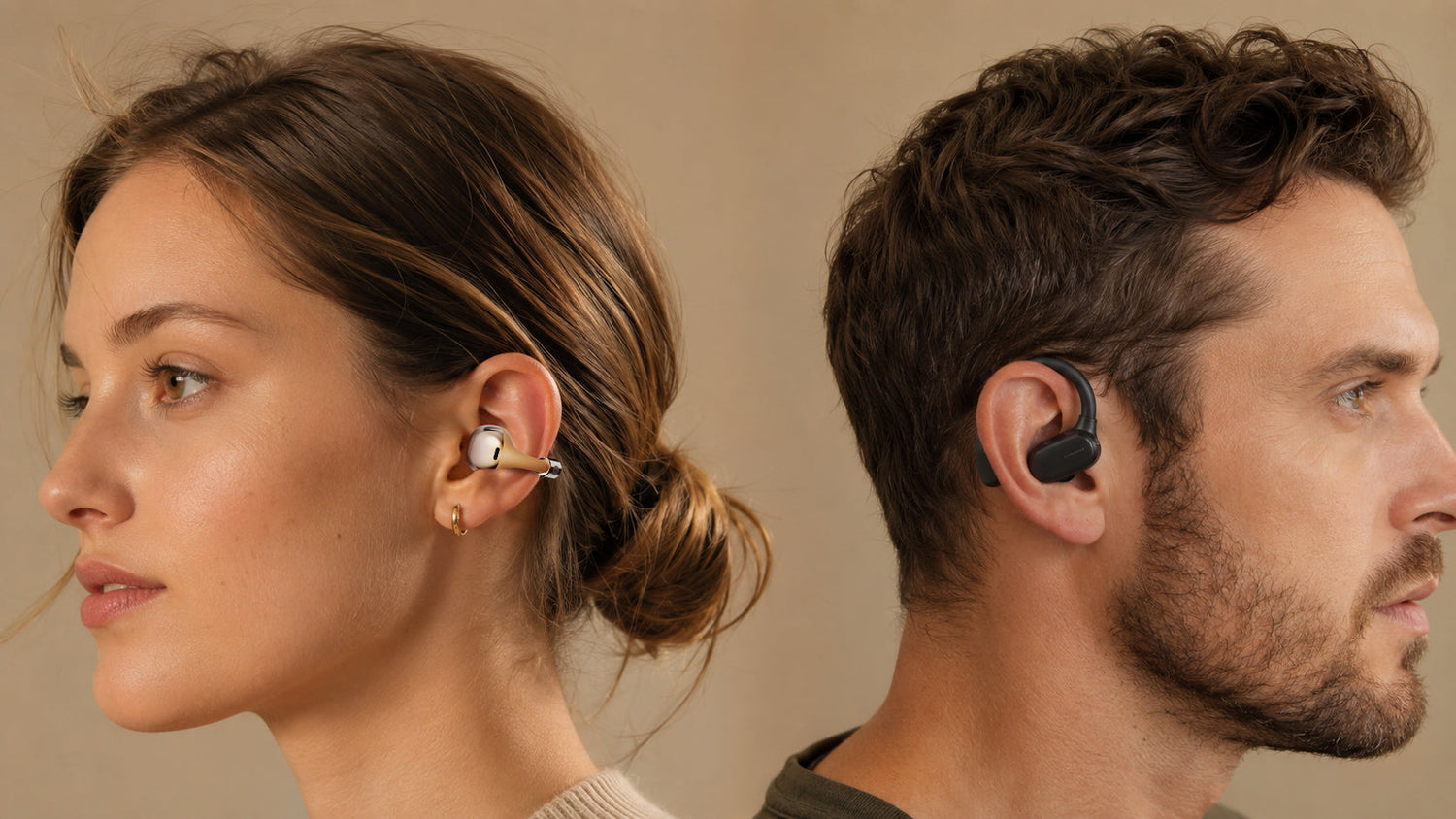
Short answer: Clip-on open-ear earbuds are often easier to wear with glasses and have a smaller, more everyday look. Ear-hook earbuds may suit people who prefer the familiar feeling of a band anchored over the ear during repeated movement. Neither design is automatically better for everyone—the right choice depends on where the earbud touches your ear and what else you wear around it.
Two pairs of open-ear earbuds can use similar audio technology and still feel different after an hour at a desk, a walk across town, or a workout with glasses on.

Both designs leave the ear canal open, but they place their weight and contact points in different areas.
Clip-On vs. Ear-Hook Earbuds: What Is the Physical Difference?
A clip-on earbud uses a flexible bridge that gently holds the outer ear between a front sound unit and a rear support section. It sits more like an ear cuff, leaving the top and back of the ear relatively clear.
An ear-hook earbud uses a curved arm that passes over the top of the ear and rests behind it. The hook acts as the main anchor while the speaker sits near, but not inside, the ear canal.
Both styles preserve environmental awareness. What changes is where you feel the earbud, how it interacts with glasses or hair, and how consistently the speaker stays in position.
| What matters | Clip-on design | Ear-hook design |
|---|---|---|
| Main contact area | Front and back of the outer ear | Top and back of the ear |
| With glasses | Usually leaves the glasses arm clear | Shares space with the glasses arm |
| Visual profile | Compact and cuff-like | More visibly sport-oriented |
| Stability feel | Balanced by bridge tension | Anchored by a hook over the ear |
| Hair, hats, and masks | Less hardware behind the ear | Can compete for space behind the ear |
| Often suits | Work, commuting, glasses, and daily wear | Users who prefer a traditional over-ear anchor |
Ear shape still matters, and a well-designed version of either style can be comfortable.
Which Fit Works Better in Real Life?
Glasses and Sunglasses
The arms of your glasses already rest across the top of the ear. An ear-hook earbud usually needs that same space. Some people can wear both comfortably, but others notice stacking, shifting, or extra pressure—especially with thicker frames.
A clip-on design attaches lower on the outer ear, so it does not need to sit on top of the glasses arm. This is one reason BUTTONS Clip uses a C-Bridge rather than a traditional hook. The structure keeps the top of the ear open and gives glasses or sunglasses their own space.
Fit still varies. Put your glasses on first, then adjust the earbuds so both settle naturally.

A clip-on structure leaves the top of the ear available for glasses instead of placing another hook in the same area.
Long-Wear Comfort
Both designs avoid inserting a silicone tip into the ear canal, but they distribute contact differently.
Ear hooks spread contact along the top and back of the ear. Some listeners like that wrapped feeling; others notice the hook more after several hours, especially with glasses, mask loops, long hair, or a hat.
Clip-on earbuds distribute contact between the front and back of the outer ear. They can feel lighter and less prominent, but bridge tension matters: too stiff can create pressure, while too loose can let the speaker shift.
BUTTONS Clip uses a flexible, shape-memory Nitinol C-Bridge that returns to its intended form through repeated wear. Each earbud weighs approximately 6.7 g, without adding a long arm over the ear.
Walking, Running, and Daily Movement
Ear hooks create a broad anchor that can feel reassuring during repeated movement. Clip-on earbuds use balanced placement and bridge tension instead.
A properly fitted clip can stay stable during walking, commuting, gym sessions, and everyday movement without adding bulk behind the ear. BUTTONS Clip uses its C-Bridge to maintain position, while its IP54 rating provides resistance to sweat and light splashes.
For intense activity, turn your head and jog in place before relying on either style. Our guide to open-ear earbuds for running, cycling, and commuting explains why awareness matters outdoors.
Sound and Calls
The clip or hook does not automatically decide which earbud sounds better. Driver quality, acoustic tuning, directional audio, and speaker position matter more.
If the speaker shifts, voices may become less clear and users may raise the volume, which can increase open-ear sound leakage.
BUTTONS Clip is designed to keep its 12 mm titanium driver consistently positioned near the ear. Directional audio focuses sound toward the listener while leaving the ear canal open.
For calls, dual beamforming microphones work with a VPU bone-conduction voice sensor to support clearer voice pickup. The VPU captures voice vibrations; it does not play music through bone conduction. Read our guide to open-ear earbuds for calls for more detail.
Why BUTTONS Chose a Clip-On Design
BUTTONS Clip is designed to move naturally between work, calls, commuting, travel, and everyday listening—not just workouts.
The design brings several practical advantages together:
- Glasses-friendly placement: No long hook needs to share the top of the ear with a glasses arm.
- Lightweight structure: Each earbud weighs approximately 6.7 g.
- Flexible support: The Nitinol C-Bridge is designed to maintain its shape through everyday movement.
- Focused open-ear sound: A 12 mm titanium driver and directional audio support clear listening without sealing the ear canal.
- Clearer voice pickup: Dual beamforming microphones and a VPU voice sensor support calls on the move.
- Refined appearance: Metal and leather-inspired detailing gives the earbuds a more wearable, fashion-conscious look.
Automatic ear adaptation also lets either earbud recognize its orientation and assign the correct left or right audio channel—one less detail to manage during the day.

BUTTONS Clip is designed to move between work, calls, commuting, and everyday life without the profile of a traditional sports ear hook.
Which Open-Ear Fit Should You Choose?
Choose clip-on open-ear earbuds if you regularly wear glasses, want less hardware behind the ear, prefer a compact look, or move between work, calls, and commuting throughout the day.
Choose ear-hook open-ear earbuds if you prefer the familiar feeling of a hook wrapped around the ear, want a broad over-ear anchor, and do not mind a larger, more performance-oriented profile.
Before deciding, try this quick fit check:
- Put on your usual glasses, hat, or mask first.
- Adjust the speaker until music and voices sound clear.
- Turn your head and move your jaw as if you were taking a call.
- Wear the earbuds for at least 15 minutes and check for a specific pressure point.
If you are also deciding between an open fit and a sealed earbud, see our open-ear vs. in-ear comparison.
Frequently Asked Questions
Are clip-on earbuds more comfortable than ear-hook earbuds?
They can be, especially for people who wear glasses or dislike hardware resting over the ear. Comfort still depends on ear shape, bridge flexibility, weight, and speaker position.
Are clip-on open-ear earbuds good for glasses?
Clip-on earbuds generally leave the top of the ear open, so they are less likely to compete with glasses arms. BUTTONS Clip attaches around the outer ear instead of looping over it.
Are ear-hook earbuds better for running?
Ear hooks provide a broad anchor that some runners prefer. A properly fitted clip-on design can also remain stable during everyday movement and light workouts. Test either style on your own ears before intense activity.
Do clip-on earbuds sound worse than ear-hook earbuds?
Not necessarily. Driver quality, acoustic tuning, directional audio, and positioning matter more than whether the earbud uses a clip or hook.
Is BUTTONS Clip a bone-conduction headphone?
No. BUTTONS Clip uses air-conduction speakers for music. Its VPU bone-conduction sensor supports voice pickup during calls. Read our open-ear vs. bone-conduction guide for the full distinction.
The Better Fit Is the One That Fits Your Day
Clip-on and ear-hook open-ear earbuds solve the same basic problem in different ways. Ear hooks create a familiar over-ear anchor. Clip-on designs keep the top of the ear clear and place less hardware behind it.
For glasses, long workdays, commuting, calls, and a more refined everyday look, the clip-on approach has a clear practical advantage. BUTTONS Clip builds on that advantage with a 6.7 g design, flexible Nitinol C-Bridge, directional audio, a 12 mm titanium driver, and dedicated voice-pickup technology.
Explore BUTTONS Clip and discover an open-ear fit designed around the way everyday life actually feels.


Leave a comment
All comments are moderated before being published.
This site is protected by hCaptcha and the hCaptcha Privacy Policy and Terms of Service apply.